

Thank you for signing up with Wealthy!
Our team will be in touch with you soon.
Watch what our Wealth Partners have to say about us
(Just a 1 minute video)
Download
Free Content

And we’ve got more for you as you wait ..


Download
Wealthy Partner App
Deliver exceptional investing
experience to your clients.


What Is Long-term Investing and Does It Really Work?
One of the most overused terms in the world of investments is “long-term”. Whenever there is a mention of investing, you’ll hear long-term along with it as well.
It has become common for us to hear and read statements like, “Investing for the long-term works better than the short-term” or “Successful investors put in their money for the long-term.” Everyone will tell you to invest for the long-term, but no one will tell you what does that actually means. Well, allow us to try.
How long is long-term?
The jury is out on this one, but 5 years and more is a reasonable amount of time to call long-term. But, of course, long-term is different for different investors. It depends on your investment goals and objectives.

Often, it might also happen that you don’t have 5 years to wait to fulfill your investment. If you have to make the down payment for a house in 3 years, then 3 years is long-term for you. On the other hand, if you have begun investing for your retirement in your 20s, then 30 years is long-term for you.
As you can see, “long-term” can be subjective. But the number of years doesn’t matter; what matters is the idea behind it.
The long-term Mindset
When an investment expert tells you to invest for the long-term, they are not telling you to invest for a particular number of years. They are asking you to have a long-term mindset, which means:
- Be patient: Investing is not a miracle that is going to make you rich overnight. It bears fruits when given time.
- Ignore short-term gyrations: The stock markets will go up and down every day, and the best thing you can do is ignore the movements. What is happening today doesn’t matter when you’re investing for 10 years or 20 years.
- Invest systematically: Make investing periodically, preferably every month, a habit that can help you build wealth over time.
To get a better understanding also read: How to get Maximum out of Power of Compounding
But does the long-term really work?
All of this sounds great, you might say, but what about the actual numbers? Let’s say you’re ready to adopt the long-term mindset and commit yourself for the long haul, but you will still need some kind of numbers to help validate your stand. Right, we get you point, which is why we have the numbers to support our claims.
We went back as far as 1999 and analyzed the rolling monthly performance of NIFTY (as a proxy for equity investing). We looked at the one-year, five-year and ten-year performance of NIFTY between 1999 and 2015.
In the graph below, all red bars are periods with losses - which you don’t want.
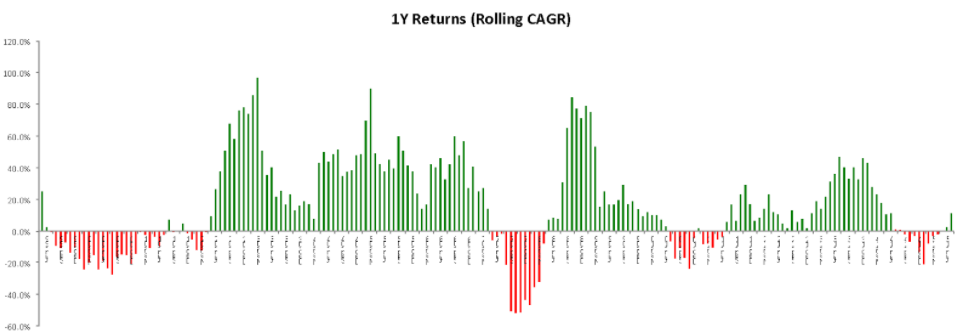
No. of ‘Loss’ Periods (Red Bars) - 62 / 195 one-year periods (32%)
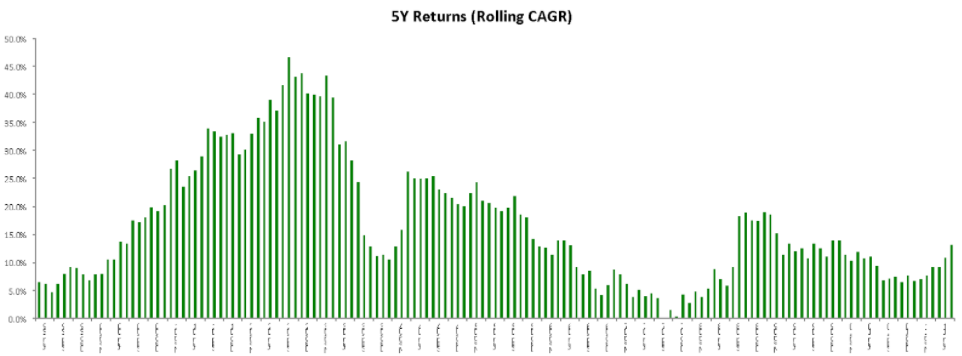
No. of ‘Loss’ Years (or red bars) - 0 / 147 five-year periods (0%)
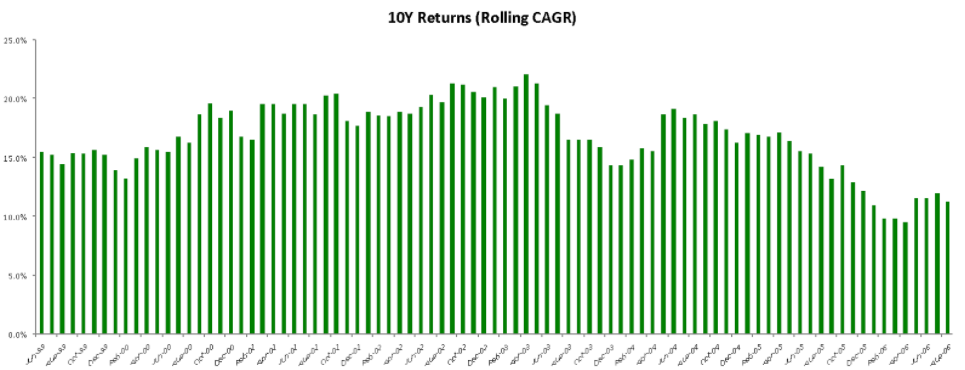
No. of ‘Loss’ Years (no red bars!) - 0 / 87 ten-year periods (0%)
Did you notice that the last two graphs (of 5 and 10-year rolling periods) don’t have any red bars?
And that is what we are trying to tell you here: As the period of investment increases, the chances of making a loss reduce dramatically.
To summarize, there were:
- 62 loss-making one-year periods out of 195
- Zero loss-making five-year periods out of 147
- Zero loss-making ten-year periods out of 87
So, yes, long-term investing does work. The longer you invest, the more chances you have to build wealth.


Download the Wealthy Appto enjoy efficient Trading and Investing!



Welcome to Wealthy


.png)
Download Wealthy Partner App
.png) Apple Store
Apple Store Play Store

