

Thank you for signing up with Wealthy!
Our team will be in touch with you soon.
Watch what our Wealth Partners have to say about us
(Just a 1 minute video)
Download
Free Content

And we’ve got more for you as you wait ..


Download
Wealthy Partner App
Deliver exceptional investing
experience to your clients.


How to Set Up an Emergency Fund?
When we are trying to reconcile the costs of dealing with an emergency, the first thing we tell ourselves is "Shit Happens." What we tend to forget is that shit keeps happening. All the time.
You might just have spent ten thousand on your laptop repair when someone close to you needs to be rushed to the hospital. At the hospital things complicate and the costs keep piling. Do you have enough cash to take care of this?
Or you lose your job when you least expect it. Do you have enough money to last till you can get another?
Smartphones fall, washing machines break, pipes burst, neighbor's kids hit a six through your car's windshield. All of these happen and happen very commonly. And they pinch when you are not prepared for them.

You might even have to break one of your FDs to deal with the immediate cash requirement. And in graver situations, you have to borrow from your retirement savings scheme or provident fund. Do you really want to wait around till such a time comes by?
Stay ahead of the game and start an Emergency Fund today.
The Emergency Savings Account
The simplest Emergency Fund is separate, accessible savings account that you don't touch until misfortune strikes. Most banks let you automatically transfer a fixed amount every month from your salary account to another savings account. We suggest you take a good look at your monthly expenses, fix a monthly amount that you can spare and automate transfers into this emergency fund till you have enough.
Ideally, "enough" means six months' worth of your must-have expenses. The must-have expenses typically include the rent, the electricity bill, the cook's salary, the EMI on your home loan, your living expenses and other stuff that you just can't compromise on.
But, it might not always be possible for you to stash that much. So, just make sure you have at least three months' worth in there. That's usually good enough to absorb the immediate shocks.
Budgeting for the Emergency
Setting aside six months of expenses (or even three months for that matter) is no easy task. If you are single and just starting out, it could mean 2-3 lakhs, but if you are a family with a new baby, it could be as high as 8-10 lakhs even. And if you are a family with two children going through higher education, even 15-20 lakhs might seem to fall short of that target.

It's easy to get intimidated by these targets, but the thing to keep in mind is that you don't have to pile up the whole amount today. You have to do it in steps. Slowly. Over the months. You have to make it a part of your monthly budget from the very beginning. And you have to do this on a high priority basis.
The best way to go ahead is to fix a monthly amount that you can spare and automate transfers into the emergency fund. You have to treat this as a must-have expense every month. Non-negotiable and non-compromisable. So it's ok to forego some of the luxury spendings initially. Even if you are setting aside only a thousand rupees this way, it is fine as long as you do that every month.
But only savings also won't do. If you truly want to achieve Financial Freedom read this: 5 Steps to Achieve Financial Freedom
Alternative Emergency Funds
Although the savings account is the easiest to manage as an emergency fund, it is also the option of a low return. This is why a few people prefer to put some of their emergency money into high liquidity investment options like Money Market Funds and Floating Rate Funds, which typically give a 7-8% annual return.
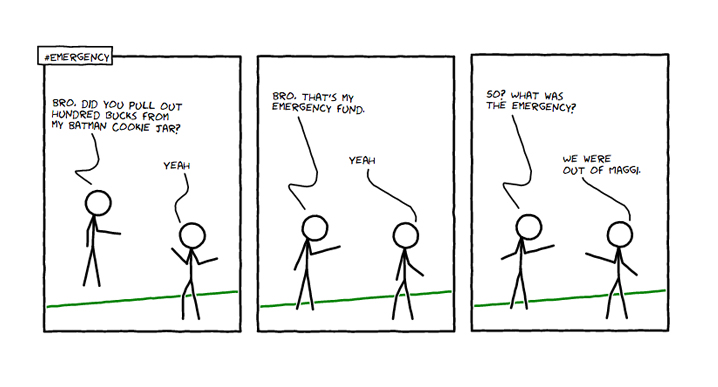
Most of these funds have no lock-in period (and if they do, it is usually never more than 3 days) and no entry or exit loads. This means, you can put in your money anytime and you can withdraw the money anytime. Withdrawals hardly take more than 1 business day.
A word of caution: Credit Card vs Emergency Fund
The monthly emergency fund contribution should ideally be of higher priority than your good-to-have expenses. That means, it should be more important than any expense you can actually live without.
The only exception to this rule is the credit card bill. It might seem like a good idea to not pay off the credit card bills fully and send that money into an emergency fund instead. It's easy to fall into the trap of thinking that paying only the interest part of the bill is OK.
Actually, it isn't. Credit cards have high-interest rates of about 30-36%. It's always better to not let this interesting pile-up. Moreover, your CIBIL score also goes down if you don't pay your credit card dues fully. And that's not good if you are looking for a housing or car loan in the near future.

However, this caution is limited to credit cards alone. In all other circumstances, your emergency fund takes priority, because to be ahead of the unexpected spendings, you have to assume that emergency events are bound to happen, and so you need to be ready for them.
Who do you know needs to start planning for an emergency? Share this article with them.


Download the Wealthy Appto enjoy efficient Trading and Investing!



Welcome to Wealthy


.png)
Download Wealthy Partner App
.png) Apple Store
Apple Store Play Store

