

Thank you for signing up with Wealthy!
Our team will be in touch with you soon.
Watch what our Wealth Partners have to say about us
(Just a 1 minute video)
Download
Free Content

And we’ve got more for you as you wait ..


Download
Wealthy Partner App
Deliver exceptional investing
experience to your clients.


Unpacking the impact of a Black Swan Event
Even though it doesn't fit the textbook definition, the outbreak of Covid-19 can be now considered a Black Swan event. This was reiterated by Sequoia Capital in a recent note to its CEOs and founders. The note advised them to "question every assumption about their business" and quoted Darwin's words to remind them that only "the most adaptable to change" will survive.
What is true for businesses is equally true for economies. By now, it is clear that there will be a wide-ranging impact that will permanently alter the balance of the economy and persist long after the pandemic is contained. In fact, we are seeing the first signs of what could be a long economic hibernation.
These include scaling down of wedding plans, shutdown of temples, theatres and the Taj Mahal, postponement of the IPL, and reduction in sale of commodities like wheat from Gujarat and cardamom from Kerala. Amidst all this, some patterns are also appearing.
Made in China goes missing
When a country that accounts for 27% of global manufacturing goes into lockdown in a few weeks, it is a shock to the global supply chain. As things stand, the shipping ministry has prevented more than 700 ships from disembarking on Indian shores. Apart from delaying raw materials to Indian firms, it increases the cost of anchorage, blocks other ships from coming in, and slows down the entire system.

Nobody is immune, but immunity still matters
Like the disease itself, the economic impact will leave nobody untouched and hurt those businesses which are already doing badly. To illustrate, given the poor state of the aviation industry, an industry body has predicted the bankruptcy of many airlines in the next two months. Offline retailers, already losing to e-commerce giants, will see a drop in footfall even as they spend more in sterilizing their premises. Restaurants, already ceding market share to food delivery, might be temporarily forced to pivot to a takeout-only model. Put simply, theatres, event management firms, or any establishment that runs on footfall will have to weather the storm or perish.
Social distancing = Economic distancing
Although "Social Distancing" is the best way to contain the disease, it also comes at a huge cost to the economy. After all, one man's expenditure is someone else's earning. And those who avoid people and cancel their engagements usually spend a lot less than others. In the US, the Federal Reserve has cut interest rates to nearly 0% even as the Trump administration considers the idea of sending checks of $1000 each for Americans.
Necessity for some, luxury for others
One major airline has asked its staff to go on unpaid leave while some luxury hotels have asked their employees to fend for themselves during the lockdown. Millions of households which lack the security of an emergency fund will have to seek work or risk starvation even as others practise social distancing.
All of the above will feed into each other
While all of the above are direct, first-order effects, each consequence will result in other consequences or second-order effects. Therefore, unless the economic fallout is contained with the same alertness as the disease itself, all of the above will combine to form a vicious cycle that will pull the economy downwards.
To reiterate what others have been saying, social distancing is the best protection and measure to contain the spread of Covid-19. From an economic perspective, it will be short-term pain and a small price to pay in our fight against this disease.
This article was first published in Businessworld here


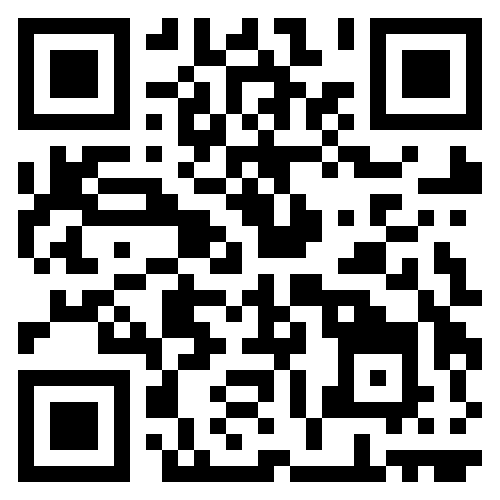
Download the Wealthy Appto enjoy efficient Trading and Investing!


Welcome to Wealthy


.png)
Download Wealthy Partner App
.png) Apple Store
Apple Store Play Store

