

Thank you for signing up with Wealthy!
Our team will be in touch with you soon.
Watch what our Wealth Partners have to say about us
(Just a 1 minute video)
Download
Free Content

And we’ve got more for you as you wait ..


Download
Wealthy Partner App
Deliver exceptional investing
experience to your clients.


Sir John Templeton, the seeker of pessimism
Before Buffett described it as "being greedy when others are fearful", there was Sir John Templeton who called it the point of maximum pessimism. While Templeton could spot opportunities during times of panic and generate great returns -- his Growth Fund generated 14% annually from 1954 to 1992 -- what separated him was the scale and audacity at which he did.
Born in 1912, Templeton graduated from Yale and then attended Oxford University. During this period, he learned two lessons: a) Good companies across the world operated just as they did in the US. b) There was no service which helped Americans invest outside the US. These two would later prove to be the founding principles of his investing career.
Investment during an invasion
When Hiter's Germany invaded Poland in 1939, an act that would trigger the Second World War, 26-year-old Templeton borrowed $10,000 and invested in 100 NYSE stocks valued at less than $1. Four years later, his portfolio had grown by 400% and he had made profit on 100 of those stocks. It was no fluke as he would explain in an interview years later, "During war, everything that was in surplus, and therefore unprofitable, becomes scarce and profitable."
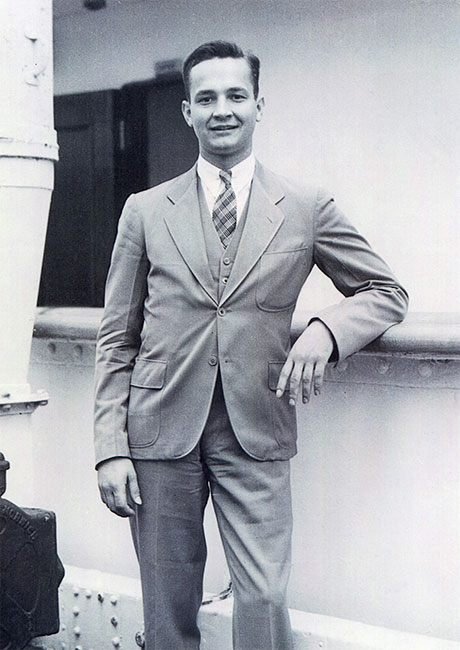 Image Courtesy - John Templeton Foundation
A love affair with Japan
Through the Templeton Growth Fund, the mutual fund he had started in 1954, he made his biggest and most rewarding investment in Japan during the 1950s. While the words “Made in Japan” today represent manufacturing excellence of an economic superpower, post-war Japan was very different. As Akio Morita, founder of Sony, recounts in his autobiography, Sony’s products in the early days would show the words “Made in Japan” in the smallest print possible.
Despite all this, Templeton noticed that the PE ratio for many Japanese companies was much lower than that of American ones. He foresaw the economic growth of Japan and started investing massively in the 1950s. At one point, 60% of the Templeton Growth Fund was focused in Japanese stocks. His faith in Japan paid off handsomely as the Japanese economy grew rapidly, often exceeding annual GDP growth of 10%. The returns of his fund easily outperformed the S&P for decades.
By the 1980s, a time when management books predicted Japan to overtake the US as the largest economy, Templeton saw that Japanese economy was overheating and an asset price bubble was building up. He pulled out of the markets before it collapsed in 1989.
 Image Courtesy - John Templeton Foundation
Searching for pessimism in Peru
In the wake of an armed internal conflict in Peru led by Shining Path, a violent political organization, the stock market collapsed and investors pulled out their money. As always, Templeton saw an opportunity and invested in the stock market by forming a Peruvian corporation. His movie was vindicated as the leadership of Shining Path was arrested and the stock market bounced back.
***
Templeton's investment firm today lives in the form of Franklin Templeton, a company that was formed when Franklin acquired Templeton's firm in 1992. A Rhodes Scholar, author of many books, and a prominent philanthropist, Templeton passed away in 2008 at the age of 95.
Quotable Quote -
“Bull markets are born on pessimism, grown on skepticism, mature on optimism, and die on euphoria. The time of maximum pessimism is the best time to buy, and the time of maximum optimism is the best time to sell."


Download the Wealthy Appto enjoy efficient Trading and Investing!



Welcome to Wealthy


.png)
Download Wealthy Partner App
.png) Apple Store
Apple Store Play Store

