

Thank you for signing up with Wealthy!
Our team will be in touch with you soon.
Watch what our Wealth Partners have to say about us
(Just a 1 minute video)
Download
Free Content

And we’ve got more for you as you wait ..


Download
Wealthy Partner App
Deliver exceptional investing
experience to your clients.


What is mutual fund distribution? A high-growth business opportunity
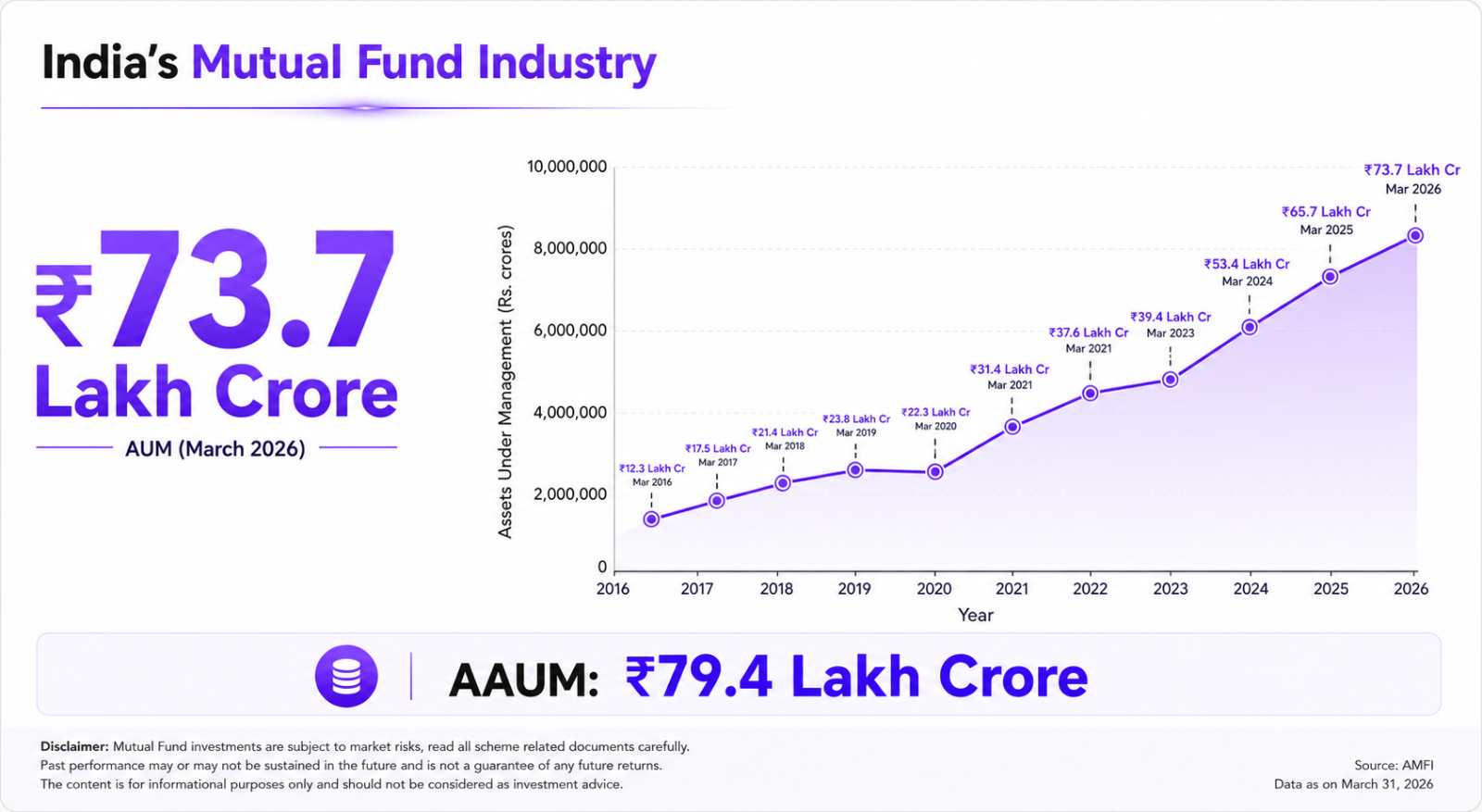
Mutual fund distribution is one of the few businesses in India where your income compounds with your clients' portfolios. Every new investor you onboard adds to a trail income of recurring commission that keeps paying out for as long as they stay invested. The Indian mutual fund industry crossed ₹82 lakh crore in AUM in February 2026 before a market correction brought it to ₹73.73 lakh crore at the end of March. Even after the dip, the industry has tripled in five years, and monthly SIP contributions touched a record ₹32,087 crore in March 2026.
If you have ever wanted to build a scalable business in finance without a large capital, or you are someone who enjoys guiding others toward better financial decisions, becoming a Mutual Fund Distributor (MFD) could be the right path for you. This is more than a career. It is a genuine business with recurring income that compounds year after year, with low startup costs and a market that is growing faster than most people realise.
This guide covers everything you need to know: what mutual fund distribution is, what an MFD actually does, how the income model works in 2026 after SEBI's new expense ratio framework and how to start your own mutual fund distribution business.
What is Mutual Fund Distribution?
Mutual fund distribution is the process of connecting investors with mutual fund schemes offered by Asset Management Companies (AMCs), through a licensed Mutual Fund Distributor who acts as the bridge between the two. The MFD helps investors identify suitable funds based on their financial goals and risk appetite, facilitates their investments and provides ongoing portfolio guidance in exchange for a commission paid by the AMC.
In simple terms: AMCs create and manage mutual fund schemes. Investors have money they want to invest. The MFD is the SEBI-regulated professional who brings them together. Every time an investor puts money into a Regular mutual fund through an MFD, the AMC pays the distributor a trail commission, a small annual percentage of the invested amount that continues for as long as the client stays invested.
This ecosystem is governed by SEBI and administered through AMFI (Association of Mutual Funds in India). Every MFD must hold a valid ARN (AMFI Registration Number) to legally distribute mutual funds and receive commissions in India. Mutual fund distribution is not about selling products. It is about helping investors make better financial decisions and building a business that earns recurring income for doing so.
What does a Mutual Fund Distributor do?
A Mutual Fund Distributor earns commissions by onboarding investors, recommending suitable schemes and servicing clients through the entire life of their investment. The role spans four core areas:
Client advisory: Understanding each client's financial goals, income, risk tolerance and investment horizon and recommending suitable mutual fund schemes based on that profile.
Transaction facilitation: Handling KYC completion, account setup, SIP mandates, lump sum investments, switches between funds and redemptions when needed.
Portfolio review and service: Monitoring client portfolios over time, reviewing performance against goals, rebalancing when necessary and communicating proactively during market volatility.
Earning through commissions: Receiving trail commission from AMCs, calculated as an annual percentage of the AUM held by their clients, paid monthly for as long as clients remain invested.
An MFD does not charge the investor directly. The AMC pays the distributor out of the scheme's expense structure, which means the investor's cost stays the same whether they invest through a distributor or invest directly in a regular fund. What changes is whether they get guidance.
The best MFDs go beyond transactions. They serve as long-term financial partners who clients call when markets fall, who explain what is happening and who help investors stay the course through volatility. This behavioural coaching is often the most valuable service an MFD provides, and it is why even in a world of direct plans and DIY investing, the mutual fund distributor business continues to grow.
How do Mutual Funds work?
A mutual fund pools money from many investors and invests it in a diversified portfolio of assets such as stocks, bonds, or a mix of both, managed by a professional fund manager at an AMC. Each investor owns units of the fund proportional to their investment, and the value of each unit, called the Net Asset Value (NAV), moves up or down based on the performance of the underlying portfolio. An example: You might have heard of Parag Parikh Flexi Cap Fund. Here, Parag Parikh (PPFAS Mutual Fund) is the AMC and Flexi Cap is a type of equity mutual fund.

Investors can put money into a mutual fund as a lump sum or through a Systematic Investment Plan (SIP), a fixed amount invested every month. SIPs are the most popular route for retail investors in India, with monthly SIP contributions touching a record ₹32,087 crore in March 2026.
Mutual Fund Type | What It Invests In | Who It Suits |
Equity Funds | Primarily stocks | Investors with a 5+ year horizon, moderate to high risk tolerance |
Debt Funds | Bonds and fixed income instruments | Conservative investors seeking stable, lower-risk returns |
Hybrid Funds | Mix of equity and debt | Investors wanting balanced exposure across asset classes |
ELSS (Tax Saving) | Equity with 3-year lock-in | Investors looking for Section 80C tax savings |
Index Funds | Tracks a market index (Nifty, Sensex) | Passive investors who prefer low-cost market returns |
This is where the mutual fund distributor becomes essential. With thousands of schemes across dozens of AMCs, most investors have neither the time nor the expertise to navigate the landscape alone. An MFD brings structure, guidance and accountability and turns what would otherwise be overwhelming into a clear, personalised plan.
Why become a Mutual Fund Distributor?
The mutual fund distributor business sits at the intersection of a massive, growing market and a profession with genuinely low barriers to entry. Here is why serious people are choosing this path in 2026:
A market that is still in its early innings
India's MF industry AUM peaked at ₹82 lakh crore in February 2026 before settling at ₹73.73 lakh crore by the end of March, a correction driven by equity market movements rather than investor exits. The longer trajectory is what matters for anyone entering the business: industry AUM has tripled in five years, growing from ₹31.43 lakh crore in March 2021 and is more than six times the ₹12.33 lakh crore it stood at a decade ago. Yet, mutual fund penetration in India stands at roughly 20 percent GDP, compared to over 100 percent in the United States. Only around 8 percent of the population invests in mutual funds, against 46 percent in the US. The overwhelming majority of Indian household savings still sit in FDs, gold and insurance. The opportunity to bring those savings into market-linked investments is enormous, and it needs qualified financial product distributors to happen.
Geographic underservice creates a clear opening
SEBI research has shown that the bottom 50 percent of districts in India contribute 17 percent of GDP but have only 4 percent of all mutual fund agents. Tier 2 and Tier 3 cities are severely underserved, which means new MFDs entering the profession today face far less competition than they would in saturated metro markets.
Recurring income that compounds
Unlike a salaried job or a one-time commission sales role, an MFD earns trail commission, a monthly income that continues as long as clients stay invested. As client portfolios grow through market appreciation and ongoing SIPs, the trail income grows with them automatically. An MFD with ₹10 crore AUM earns approximately ₹7 lakh per year in trail commission. At ₹50 crore AUM, that figure reaches nearly ₹35 lakh. The income does not reset. It compounds.
Flexible, scalable, low entry cost
There is no office requirement, no inventory and no geographic restriction on who you can serve. The mutual fund distribution business can be run from home, part-time or full-time and scaled through digital platforms without proportional increases in operational cost. The total cost to get licensed and operational as an MFD is under ₹6,000, covering the NISM exam fee, KYD processing and ARN registration. Few businesses in India offer a comparable combination of low startup cost, professional credibility and long-term income potential.
Opportunity to cross-sell other financial products
There is no restriction on an MFD to limit their income to the trail commission earned from mutual funds only. An MFD can offer its clients Insurance, DEMAT, PMS, FDs, Bonds, and other financial products that the client is interested in. A client’s financial and safety needs tend to vary with their future income levels. An MFD has the opportunity to serve their clients and, in the process, earn commissions from the manufacturers of these financial products.
Business Model and Income Potential of a Mutual Fund Distributor
The mutual fund distribution business runs on a trail commission model, and understanding how it works in the new 2026 regulatory environment is the key to understanding the business's long-term income potential.
When a client invests in a Regular Plan mutual fund through an MFD, the AMC pays a distributor commission linked to the scheme's expense structure. Under the SEBI (Mutual Funds) Regulations 2026, effective April 1, 2026, this expense structure has been restructured. The old Total Expense Ratio (TER) has been replaced with a Base Expense Ratio (BER) model, and statutory levies such as GST, STT and stamp duty now sit outside the BER and are charged on actuals. For the MFD, the practical impact is that commissions are now paid GST-exclusive. GST-registered distributors receive base commission plus GST, while distributors without GST registration receive only the base commission.
Trail commission for equity funds typically ranges between 0.20 percent and 1.00 percent per annum, paid monthly based on the current market value of the client's investment.
How Trail Commission Works: A Simple Example
Client invests ₹10,00,000 in an equity mutual fund through your ARN
AMC pays you 0.70 percent trail commission per annum
Your annual income from this client: ₹7,000
If the investment grows to ₹15,00,000 over 3 years, your income grows to ₹10,500 per year, with no additional work.
Multiply this across 300 to 500 clients, and the compounding effect is significant.
This is why building a mutual fund distribution business rewards patience and consistency above almost anything else. The income in year one is modest. But by year three to five, as AUM compounds through market growth, ongoing SIPs and new client additions, trail income reaches levels that rival a senior professional's salary, and it keeps growing.
AUM-to-Income Ladder
AUM Level | Approx. Annual Trail Income (0.7%) | Monthly Equivalent (approx) |
₹5 Crore | ₹3.5 Lakh | ₹29,000 |
₹10 Crore | ₹7 Lakh | ₹58,000 |
₹25 Crore | ₹17.5 Lakh | ₹1,45,000 |
₹50 Crore | ₹35 Lakh | ₹2,90,000 |
₹100 Crore | ₹70 Lakh | ₹5,80,000 |
Figures above assume a blended trail rate of approximately 0.7 percent across a diversified equity and hybrid fund portfolio. Actual income varies based on fund category mix, client retention and market conditions.
A well-structured mutual fund distribution business plan focuses on three things: building AUM consistently through new client acquisition, retaining existing clients through strong service and communication and leveraging a platform like Wealthy.in to handle the operational burden so more time goes into client relationships.
Start your MFD Journey with Wealthy
Wealthy.in is the platform built for MFDs who are serious about building a real business, not just collecting an ARN and hoping for the best. Whether you are starting your first client relationship or managing a ₹100 crore practice, Wealthy provides the technology, compliance support and business infrastructure to help you grow faster and operate more efficiently.
One platform, all AMCs: Multi-AMC access from a single dashboard, with no separate empanelment paperwork.
Frictionless onboarding: Digital KYC and seamless client onboarding, with the ability to start SIPs in minutes, not days.
Full financial visibility: Real-time AUM tracking and commission statements consolidated from every AMC in one place.
Professional client experience: Client-facing portfolio dashboards that build trust and reduce unnecessary calls.
Compliance handled: ARN renewal reminders, CPE tracking and alerts built into the workflow, including support for the 2026 GST and regulatory transition.
Expanded product suite: Beyond mutual funds, offer PMS, AIF, insurance, SIFs, Bonds, FDs and more from the same platform to grow revenue per client.
MFD community: A network of serious MFDs across India offering peer support, best practices and shared growth.
Wealthy.in is not a generic fintech platform. It is built for one purpose: giving mutual fund distributors in India the tools they need to build practices that last. Become a Wealthy Partner and join thousands of MFDs who are building India's most trusted financial distribution network.
Conclusion
Mutual fund distribution is one of the most compelling business opportunities in India today. The market is large and still growing, with industry AUM tripling in five years and monthly SIP contributions at record levels, and the vast majority of India's investable population yet to be reached. The income model is genuinely recurring and compounds with time. The entry barriers are low, the flexibility is real, and the long-term financial upside for a consistent, relationship-driven MFD is significant.
Whether you are exploring this as a second income, a career transition, or a full-scale business, the mutual fund distribution business has a place for you. The tools exist. The market is there. And platforms like Wealthy.in exist to make the journey faster and more efficient than starting alone.
Ready to Build Your MFD Business?
Join 10,000+ MFDs across India who are building serious, scalable distribution practices on Wealthy.in. Become a Wealthy Partner and leverage Wealthy’s technology-driven platform to deliver a superior investing experience.
Disclaimer: Mutual fund investments are subject to market risks. Read all scheme-related documents carefully.
© 2026 Wealthy. For educational purposes only. Not financial, legal, or regulatory advice. Mutual fund investments are subject to market risks. Read all scheme-related documents carefully.


Download the Wealthy Appto enjoy efficient Trading and Investing!



Welcome to Wealthy


Become a Wealthy Partner
Join 6,000+ partners earning with Wealthy


By joining, you agree to Wealthy's Privacy Policy and Terms of Service.
.png)
Download Wealthy Partner App
.png) Apple Store
Apple Store Play Store
Latest Blogs
FAQs
What is a mutual fund distributor?

A mutual fund distributor (MFD) is a SEBI-regulated professional licensed to distribute mutual fund schemes to investors. MFDs hold an AMFI Registration Number (ARN) and earn trail commission from AMCs on the investments their clients make through Regular Plans. They serve as the bridge between retail investors and Asset Management Companies, providing advisory, transaction support and ongoing portfolio servicing for the life of the investment.
How does a mutual fund distributor earn money?
MFDs earn trail commission, an annual percentage of the AUM held by their clients in Regular Plan mutual funds. This commission is paid monthly by the AMC and continues as long as clients remain invested. As client portfolios grow through market appreciation and SIP contributions, the MFD's trail income grows automatically. Equity funds typically pay 0.20 to 1.50 percent trail per annum. From April 1, 2026, under SEBI's new Base Expense Ratio framework, commissions are paid GST-exclusive, meaning GST-registered distributors receive base commission plus GST, while unregistered distributors receive only base commission.
How do I start a mutual fund distribution business?
To start a mutual fund distribution business, follow three steps. First, pass the NISM Series V-A Mutual Fund Distributors Certification Examination, which is a 100-question, 2-hour exam with a 50 percent pass mark and a fee of around ₹1,500 plus GST. Second, apply for your ARN at amfiindia.com after completing the KYD process, with a registration fee of approximately ₹3,000 plus GST. Third, join a distribution platform like Wealthy.in for multi-AMC access, digital KYC and consolidated commission tracking. Total startup cost is under ₹10,000, and the full process typically takes 8 to 12 weeks.
Who can become a mutual fund distributor in India?
Any Indian resident who is 18 years or older and has passed Class 10 can become a mutual fund distributor. There is no income requirement, no professional degree requirement and no prior finance experience needed. The only mandatory steps are passing the NISM Series V-A exam and registering for an ARN with AMFI. Salaried professionals, homemakers, retirees, LIC agents and fresh graduates are all eligible.
What certifications or registrations are required to start?
Two things are mandatory. First, the NISM Series V-A Mutual Fund Distributors Certification Examination, a 100-question exam conducted by the National Institute of Securities Markets (NISM) at centres across India, with a 50 percent pass mark. Second, an ARN (AMFI Registration Number) is applied for online at amfiindia.com after passing NISM V-A and completing the Know Your Distributor (KYD) process. No other certification is required to begin. For distributors expecting annual commission income above ₹20 lakh, GST registration is also mandatory, and from April 2026, registered GST status also affects how commission payouts are calculated.
What is the difference between a mutual fund distributor and an investment advisor?
A Mutual Fund Distributor (MFD) distributes Regular Plan mutual funds and earns trail commission paid by the AMC, not by the client. A SEBI-Registered Investment Advisor (RIA) charges the client a direct fee for advice and recommends Direct Plans. MFDs are regulated through AMFI under SEBI, while RIAs are directly registered with SEBI and face higher qualification, net worth and compliance requirements. Most practitioners in India operate as MFDs because the model is more accessible and better suited to the current market structure.
How have the SEBI 2026 regulations changed MFD commissions?
The SEBI (Mutual Funds) Regulations 2026, effective April 1, 2026, replaced the old Total Expense Ratio (TER) with a Base Expense Ratio (BER) model and moved statutory levies such as GST, STT and stamp duty outside the BER, to be charged on actuals. For MFDs, this means commissions are now paid GST-exclusive. A commission rate previously quoted as 1 percent inclusive of GST will now be paid as approximately 0.85 percent base, plus 18 percent GST, only to GST-registered distributors who submit valid tax invoices. The change effectively removes the GST arbitrage that unregistered distributors previously enjoyed and pushes the industry toward more professional, registered operators.
Can mutual fund distribution be a part-time or full-time business?
Mutual fund distribution works well in both modes. Many distributors start part-time alongside a full-time job, servicing friends, family and colleagues before going full-time once AUM crosses a meaningful threshold. The low entry cost, absence of inventory and digital-first workflow make it one of the few financial services businesses that can genuinely be run on the side in early years and scaled into a full practice over time. Many of India's most productive MFDs manage over ₹50 crore AUM entirely from home, serving clients across multiple cities.
